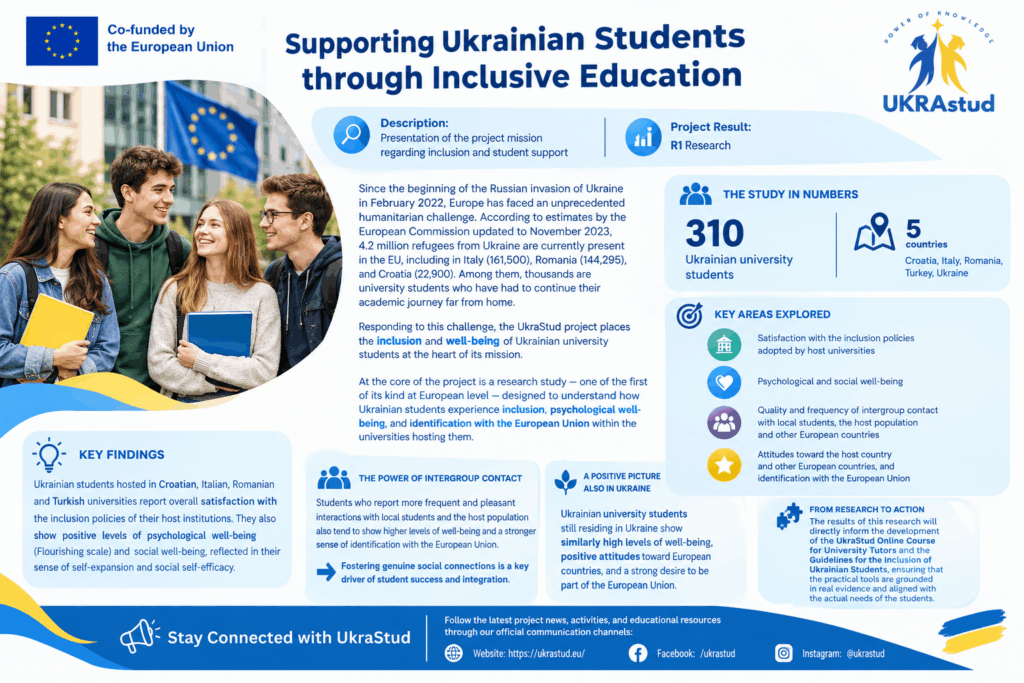
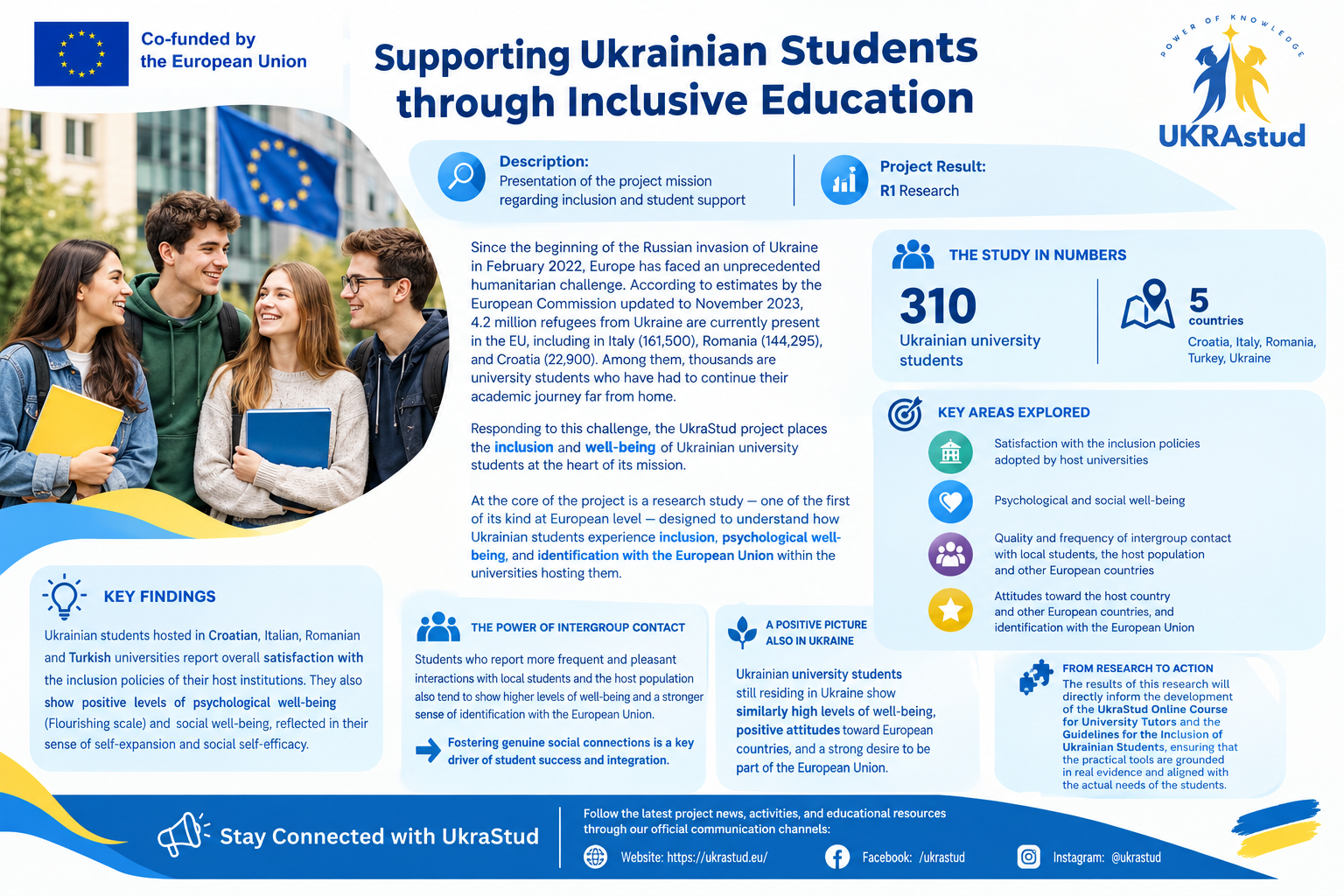
Since the beginning of the Russian invasion of Ukraine in February 2022, Europe has faced an unprecedented humanitarian challenge. According to estimates by the European Commission updated to November 2023, 4.2 million refugees from Ukraine are currently present in the EU, including in Italy (161,500), Romania (144,295), and Croatia (22,900). Among them, thousands are university students who have had to continue their academic journey far from home. Responding to this challenge, the UkraStud project places the inclusion and well-being of Ukrainian university students at the heart of its mission. At the core of the project is a research study — one of the first of its kind at European level — designed to understand how Ukrainian students experience inclusion, psychological well-being, and identification with the European Union within the universities hosting them.
The study involved 310 Ukrainian university students across five countries: Croatia, Italy, Romania, Turkey, and Ukraine. Through an online questionnaire, researchers explored key dimensions of the students’ experience, including:
- their satisfaction with the inclusion policies adopted by host universities;
- their psychological and social well-being;
- the quality and frequency of their intergroup contact with local students, the host population, and other European countries;
- their attitudes toward the host country and other European countries, and their identification with the European Union.
The findings offer an encouraging picture. Ukrainian students hosted in Croatian, Italian, Romanian, and Turkish universities report overall satisfaction with the inclusion policies of their host institutions. They also show positive levels of both psychological well-being — measured through a Flourishing scale — and social well-being, reflected in their sense of self-expansion and social self-efficacy. Importantly, the research highlights that positive intergroup contact matters. Students who report more frequent and pleasant interactions with local students and the host population also tend to show higher levels of well-being and a stronger sense of identification with the European Union. This finding points to a clear direction for universities and tutors: fostering genuine social connections is a key driver of student success and integration.
The research also reveals that these positive dynamics are not limited to students living abroad. Ukrainian university students still residing in Ukraine show similarly high levels of well-being, positive attitudes toward European countries, and a strong desire to be part of the European Union — a finding that underlines the importance of European solidarity and cooperation in higher education. The results of this research will directly inform the development of the UkraStud Online Course for University Tutors and the Guidelines for the Inclusion of Ukrainian Students, ensuring that the practical tools produced by the project are grounded in real evidence and aligned with the actual needs of the students they aim to support.
Stay Connected with UkraStud
Follow the latest project news, activities, and educational resources through our official communication channels:
🌐 Website: https://ukrastud.eu/
📘 Facebook: https://www.facebook.com/profile.php?id=61578566666789
📸 Instagram: https://www.instagram.com/ukrastud/